TAX & BUSINESS
All Forms
Find wage statements, taxpayer information forms and business documents.
Browse forms
Check the employee Social Security deduction for either supported year, including a paycheck that reaches the annual covered-wage limit.
Use the calculator free. Preparing a pay stub is a separate paid service.
Pay stub designs · Simple starts at $3.99 ↗
Calculate this employee tax on its own.
Annual employee tax reference
Employee Social Security tax only. This does not estimate retirement benefits or take-home pay.
| Tax component | Amount |
|---|---|
| Employee Social Security tax · 6.2% | $4,650.00 |
| Total employee tax | $4,650.00 |
Each average is rounded separately. Adding the rounded components may differ from the rounded total by one cent.
Example: $75,000 annual covered wages · 2026
Estimating pay costs nothing. Document preparation is a separate purchase: enter figures from your records, choose a layout and check the preview.
Simple costs $3.99 per stub. Compare the price of your selected design and any extras before you pay.
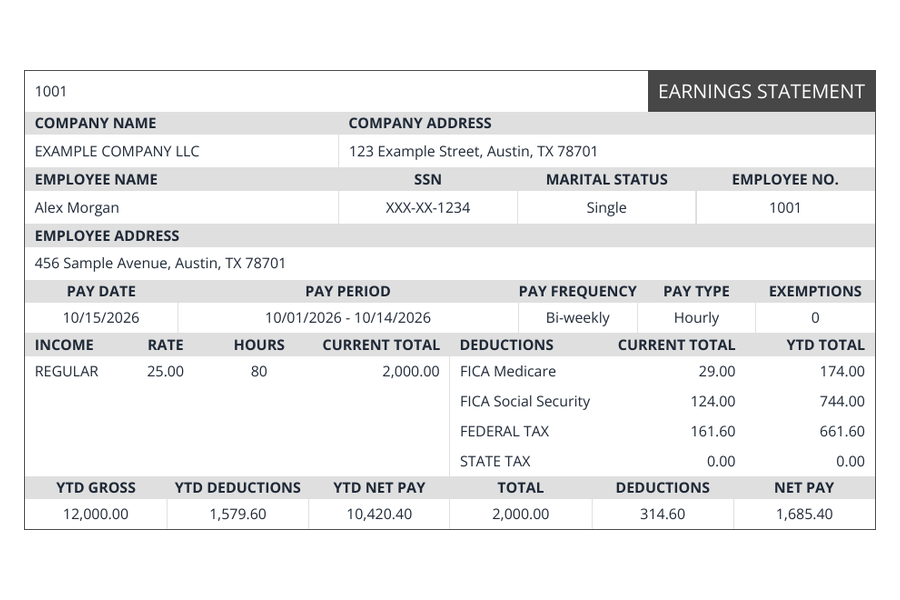
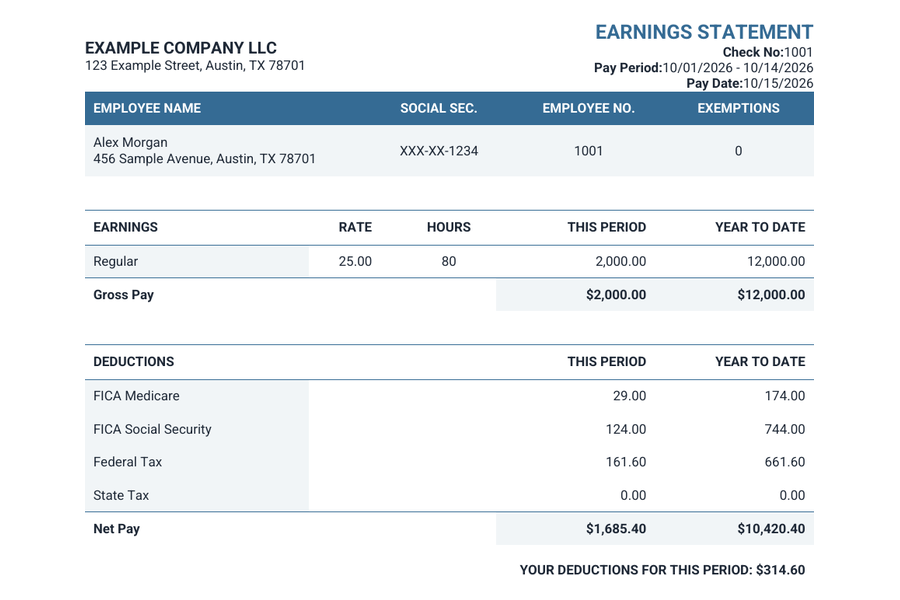
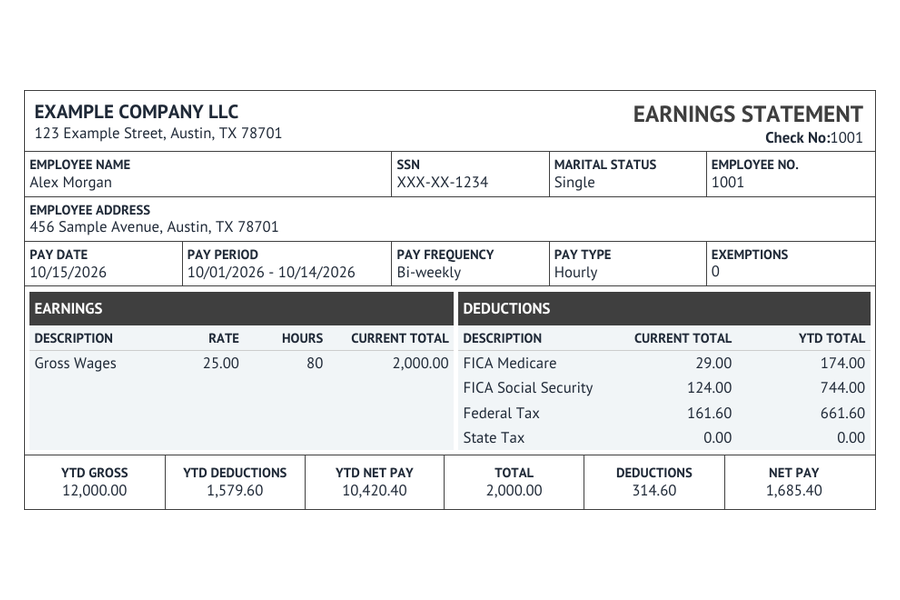
Illustrations use fictional details. Each design has its own price; calculator inputs stay separate from document orders.
Find wage statements, taxpayer information forms and business documents.
Browse formsBring the position, compensation and employment terms into one letter.
Create an offer letterDescribe your services, itemize charges and make payment details easy to find.
Explore invoicesOrdinary Social Security-covered employee wages use a 6.2% rate up to the calendar year’s contribution and benefit base. The selected year determines the cap.
The 2025 wage base is $176,100, giving a $10,918.20 employee annual maximum before per-check rounding. For 2026, the base is $184,500 and the corresponding maximum is $11,439.00. The employee rate remains 6.2% in both years.
Annual mode applies the rate once to annual covered wages up to the cap. It is a reference before differences from rounding individual checks; the schedule only changes the average display. Paycheck mode uses prior same-employer covered wages to find how much of this check remains under the cap.
Prior YTD wages must be from the same employer and calendar year and must exclude the current check. A zero balance assumes no earlier covered wages. The calculation does not reconcile prior taxes actually withheld or correct a payroll overcollection.
Unrelated employers generally apply the wage limit separately. Excess employee withholding across employers may be addressed on a tax return, while overcollection by one employer follows different rules. Refer to the IRS guidance before treating a calculator difference as a refund.
Suppose prior covered wages from this employer are $183,000 and the next check contains $3,000 of covered wages. Only $1,500 fits below the 2026 limit, so this check’s employee deduction is $93.00. In 2025, that same prior balance already exceeds the year’s limit and the next check has no Social Security withholding in this model.
No. This is the employee share. The employer’s matching contribution is separate.
Employers round each check. The annual reference makes one annual calculation, and separately rounded average components may differ from a displayed total by one cent.
No. It covers ordinary employee payroll tax, not benefits, taxation of benefits, railroad retirement or self-employment tax. Special employment exemptions require a separate review.
Select the payroll year you want to model and supply the correct taxable or covered wage basis. This calculator does not classify benefits or decide whether wages are taxable.
Rules were reviewed on October 26, 2026 for the two supported years. Later changes require another review. Use the result as a planning comparison alongside payroll records, rather than as a tax-return calculation.
Enter earnings and deductions from your records, select a document design and review the preview before payment.